Title
Excerpt
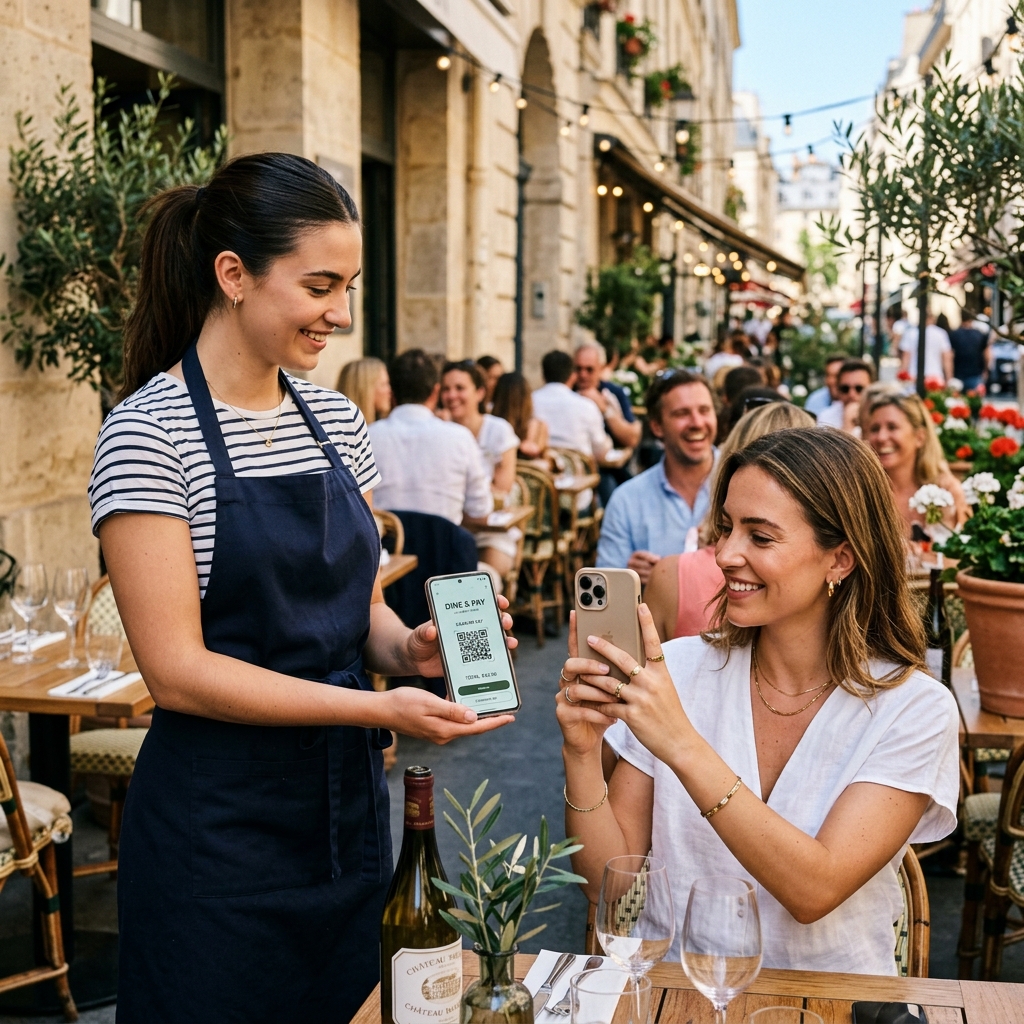
For most of the card era, accepting a payment meant owning a payment terminal: a leased card machine, a merchant contract, and a tangle of fees. QR-based payments quietly dismantle that assumption. When the customer's own phone becomes the payment device, a restaurant can accept money anywhere without a single dedicated terminal. This article explains how zero-hardware QR payments work, why they matter for cost and flexibility, how they stay secure and compliant, and where they fit alongside traditional card acceptance.
The old model: renting the ability to get paid
Traditional card acceptance bundles several costs, many of them recurring: terminal rental or purchase, a merchant-services contract, per-transaction processing fees, and sometimes minimum monthly charges. Each terminal is a fixed asset tied to a fixed location — the till, the counter — which constrains where and how you can take payment. Adding a pop-up, a terrace, or a queue-buster means adding more hardware and more contracts. The ability to get paid, in other words, was something you rented in physical units.
What zero-hardware QR payments are
Zero-hardware QR payment means the customer pays using their own smartphone, with no dedicated card machine on the restaurant's side. The flow is simple: the customer scans a QR code — on the table, on a receipt, on a counter card, or presented on a staff device — which opens a secure hosted checkout in their browser. They pay with a saved card or a mobile wallet such as Apple Pay or Google Pay, confirm with their phone's biometrics, and the payment is done. The funds route through a compliant processor to the restaurant's account.
The device that used to be the restaurant's most expensive piece of payment hardware — the card terminal — is replaced by a device every customer already owns and trusts: their phone.
Because the payment page is hosted by a PCI-compliant processor and the customer authenticates on their own device, sensitive card data never touches the restaurant's systems at all. The QR code is just a pointer to a secure checkout; the security lives in the processor and the customer's phone.
Why it matters: cost, flexibility, speed
Lower and clearer cost
With no terminals to lease and no per-device contracts, the cost of acceptance collapses to standard per-transaction processing fees — typically a small percentage plus a fixed amount. There is no separate rental line, no minimum-terminal commitment, and the cost scales naturally with sales rather than with how many physical machines you own.
Payment anywhere
Without hardware tying payment to a fixed point, you can take money wherever the customer is: at the table, on the terrace, in the queue, at a festival stall, or at a pop-up with nothing but staff phones. Every square metre becomes a potential point of sale, and you can flex capacity up for a busy event and back down again with zero equipment change.
Faster checkout and fewer bottlenecks
Paying by wallet on your own phone is often faster than fishing out a card, waiting for a terminal, and entering a PIN. When several customers can pay simultaneously from their own devices, the single-terminal queue disappears — which speeds table turns and shortens counter lines at exactly the moments that matter.
Security and trust
A reasonable question is whether phone-based QR payment is as safe as a terminal. In practice the architecture is very strong precisely because the restaurant is removed from the sensitive path:
- Card data is tokenised and handled by a PCI-compliant processor, not stored or seen by the restaurant.
- The customer authenticates on their own device, usually with biometrics, which is a robust second factor.
- Wallets add another layer, replacing the real card number with a device-specific token so the actual number is never transmitted.
- Hosted checkout reduces the restaurant's PCI scope, lowering both risk and compliance burden.
One legitimate concern is QR-code tampering — a bad actor replacing a table sticker with a malicious code. The mitigations are practical: use codes that resolve to your own verified domain, prefer dynamic codes generated by your system over static printed ones where possible, brand the checkout clearly so customers can recognise it, and train staff to check that displayed codes have not been overlaid. As with any payment method, a little operational hygiene goes a long way.
Compliance comes along for the ride
A payment is only half a transaction; the other half is a compliant receipt and a correctly-recorded, correctly-taxed sale. The strongest implementations tie QR payment to the ordering and fiscal-compliance layers so that paying automatically produces a compliant, correctly-taxed receipt and a tamper-evident record. That means zero-hardware payment does not create a compliance gap — the sale is recorded and receipted exactly as it would be through a traditional till, just without the traditional hardware.
Where Nigmet fits
Nigmet is an AI-native restaurant operating system in which QR payments are part of the core, not a separate gadget. Customers pay by scanning a code and using a saved card or mobile wallet on their own phone; funds settle to the restaurant's own bank account through a PCI-compliant processor with transparent per-transaction fees. Because payments, QR ordering, and fiscal compliance are one platform, every QR payment is automatically receipted and taxed correctly and recorded in a tamper-evident form. The result is card-quality acceptance — anywhere in the venue, on staff or customer phones — with no terminals to lease and no compliance gap.
The payment flow, step by step
It is worth walking through exactly what happens in a zero-hardware QR payment, because the detail explains both the speed and the security:
- Present. A QR code is shown — printed on the table, on a receipt, or generated dynamically on a staff device tied to the specific bill.
- Scan and load. The customer scans with their phone camera, and a secure hosted checkout opens in the browser showing the amount due.
- Authenticate and pay. The customer pays with a saved card or a mobile wallet, confirming with the phone's biometrics.
- Confirm. The payment is authorised in seconds, both customer and restaurant see confirmation, and the sale is closed.
- Settle. Funds clear and are paid out to the restaurant's account on the processor's schedule.
At no point does the restaurant touch the card number. The sensitive data flows between the customer's device, their bank, and the PCI-compliant processor — which is precisely why removing the terminal does not weaken security.
Strong Customer Authentication and PSD2
In Europe, electronic payments are governed by regulations that require Strong Customer Authentication (SCA) — broadly, verifying the payer through two independent factors, such as something they have (their phone) and something they are (a fingerprint or face). Phone-based QR payment fits this framework naturally: the customer's own device and biometrics satisfy the authentication requirement smoothly, often more smoothly than entering a PIN on a shared terminal. Rather than being an obstacle, SCA is largely invisible in a well-designed wallet payment, because the phone handles it in the background.
Wallets, and how this differs from tap-to-pay on a phone
Two phone-centric payment ideas are sometimes confused. QR payment puts the transaction on the customer's phone: they scan and pay on their own device. Tap-to-pay on a phone — sometimes called SoftPOS — turns a staff member's phone into a contactless reader that the customer taps their card or phone against. Both remove the dedicated terminal, and they are complementary. QR payment excels for table service and self-service because it scales to every customer's device at once and needs no staff involvement; SoftPOS excels when a staff member is taking payment in person and the customer wants to tap a physical card. A modern platform can support both, letting you meet customers wherever they are on the spectrum from full self-service to fully staffed.
Tips, refunds, and the practical details
Real payment life includes tips and the occasional refund, and a good QR payment flow handles both cleanly. Tipping can be offered within the checkout as clear, optional prompts, captured and reported correctly for payroll and compliance. Refunds should be issuable back to the original payment method without physical-card gymnastics, with a clear record tying the refund to the original sale. These everyday details determine whether the system is pleasant to run, not just impressive in a demo.
What happens offline
Because QR payment depends on connectivity, resilience matters. Sensible implementations degrade gracefully: if the customer's connection is momentarily poor, the checkout should recover rather than fail silently, and the restaurant should always have a fallback path (such as a staff-device payment) so a shaky signal never leaves a customer unable to pay. As with any connected system, the right question is how the flow behaves under imperfect conditions, not just in the ideal case.
A simple cost illustration
Consider an illustrative comparison of acceptance cost. A traditional setup might carry a monthly terminal rental per device plus per-transaction processing fees. A zero-hardware QR setup carries only the per-transaction processing fees. On, say, a €12 average ticket, the per-transaction cost is a small percentage plus a fixed fee either way — but the QR setup eliminates the recurring rental entirely, and it eliminates the need to buy another terminal every time you want another point of sale. Across a year and multiple would-be terminals, the removed rental and hardware cost is the visible saving; the flexibility to take payment anywhere is the less visible but often larger benefit.
Where terminals still make sense
Zero-hardware payment is not a demand to throw away every card machine. Some customers prefer to tap a physical card, some venues want a dedicated tap-to-pay reader at the counter, and cash will not vanish overnight. The pragmatic stance is that QR payment removes the requirement for a terminal at every point of sale, dramatically lowering the cost and rigidity of acceptance, while you keep whatever additional methods your customers actually want. It is about optionality, not orthodoxy.
Getting adoption right
The technology only pays off if customers actually use it, and adoption is a matter of design and framing more than persuasion. Make the code impossible to miss and pair it with a concrete benefit — "scan to pay and skip the queue" is more compelling than a bare code. Keep the first payment effortless so the experience earns a second one. Train staff to offer it naturally and to help anyone who hesitates rather than leaving them stranded. And always keep a human-assisted fallback so no customer ever feels trapped by a method they did not choose. Handled this way, QR payment tends to become the default surprisingly quickly, because tapping a phone you are already holding is genuinely easier than the alternative.
It is also worth remembering that payment is the final impression of a visit. A fumbled, slow, or awkward checkout can sour an otherwise excellent meal, while a smooth, instant one leaves the customer feeling the whole experience was effortless. Removing the terminal is not only a cost decision; done well, it is a hospitality decision that improves the last moment a customer spends with you. And because the customer pays on their own familiar device, that final moment feels natural rather than mechanical, which is exactly the impression you want them to carry out the door and remember next time.
The bottom line
Zero-hardware QR payments turn the customer's phone into the payment device, eliminating terminal rentals and per-device contracts, collapsing the cost of acceptance to transparent per-transaction fees, and letting you take money anywhere in the venue. The architecture is secure precisely because the restaurant is removed from the sensitive card path, and when it is tied to ordering and compliance, every payment is automatically receipted and correctly taxed. Keep the payment methods your customers love, but stop paying to rent the ability to get paid — the most capable payment terminal in your restaurant is already in your customer's pocket.
Ready to accept payments without the hardware bill? Compare processing and plans on our pricing page.