Title
Excerpt
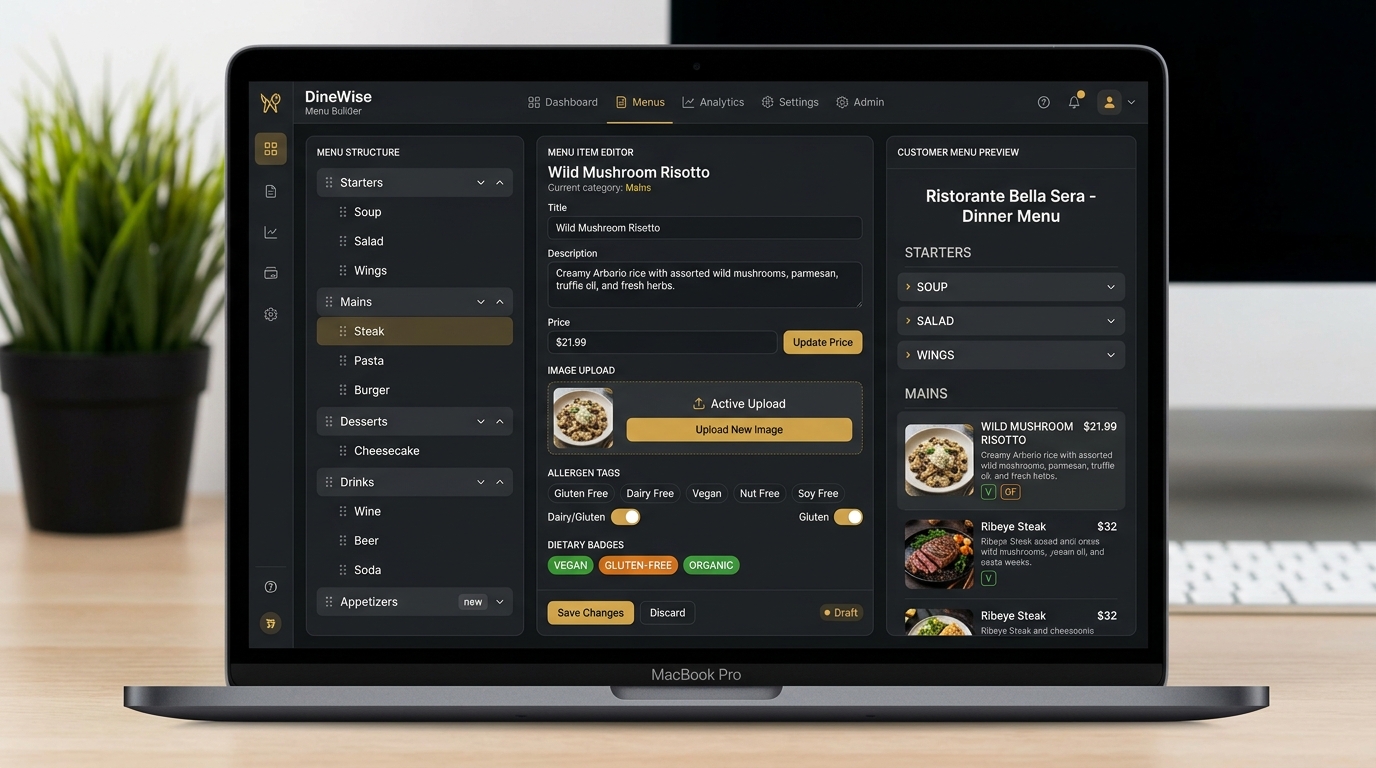
Food-cost inflation is the quiet emergency of modern hospitality. Ingredient prices move constantly and unevenly, yet most restaurants still price their menus as though costs were fixed for a year at a time. The result is margin erosion that goes unnoticed until it shows up as a bad month. This article explains how to think about menu pricing as a living system, what "dynamic menus" mean in practice, and how data-driven pricing and menu engineering protect margin without alienating customers.
Why fixed menus lose money in an inflationary world
A printed menu encodes a set of pricing decisions and then freezes them. Meanwhile, the cost of the ingredients behind each dish keeps moving — sometimes gently, sometimes violently, and rarely in unison. When the price of a key ingredient rises 20% but the menu price stays flat for another six months, the margin on that dish silently collapses. Multiply that across a menu of dozens of items and the aggregate effect can turn a profitable operation into a struggling one without any single obvious cause.
The core problem is a mismatch of speed: costs change weekly, menus change annually. Closing that gap is what "dynamic menus" is really about.
What "dynamic menu" actually means
Dynamic does not mean chaotic or surge-priced like a ride-hailing app. In a restaurant context it means the menu is a living artefact that can be updated quickly and deliberately in response to costs, demand, availability, and time of day. It spans a spectrum:
- Responsive repricing. Updating prices promptly when input costs move materially, rather than waiting for an annual reprint.
- Dayparting. Different menus and prices for breakfast, lunch, happy hour, and dinner — matching offering to demand and cost.
- Availability-driven menus. Automatically hiding sold-out or out-of-season items and promoting what you have in abundance.
- Demand-aware promotions. Pushing slow-moving, high-margin items during quiet periods and easing off discounts when demand is already strong.
The enabling technology is a digital menu — QR ordering and digital signage — because you cannot practically do any of this with laminated boards. When the menu is digital, a price change propagates everywhere instantly.
Costing before pricing: know your plate cost
You cannot price dynamically if you do not know what a dish costs, and this is where many restaurants are flying blind. The foundation is a recipe-level cost, sometimes called plate cost: the sum of the cost of every ingredient in a dish at current prices. Once you have that, the food-cost percentage — plate cost divided by menu price — becomes the number you actually manage.
Illustrative example: if a dish costs €4.00 in ingredients and sells for €16.00, its food-cost percentage is 25%. If the ingredient cost climbs to €5.20 and the price stays at €16.00, food cost jumps to 32.5% — and every one of those extra points comes straight out of profit.
Keeping plate costs current is the unglamorous heart of inflation survival. When ingredient prices are connected to recipes, the system can flag exactly which dishes have drifted out of their target food-cost band and by how much, so you act on the items that matter instead of guessing.
Menu engineering: not every dish should be repriced
Raising every price in lockstep is a blunt instrument that annoys customers and ignores how menus actually work. Menu engineering offers a smarter frame by classifying items along two axes — popularity and profitability:
- Stars — popular and profitable. Protect them, feature them, and reprice them carefully and sparingly.
- Plowhorses — popular but low-margin. These are where inflation hurts most; consider modest price increases, portion adjustments, or recipe reformulation.
- Puzzles — profitable but unpopular. Promote them harder or reposition them on the menu and screens.
- Dogs — unpopular and unprofitable. Candidates for removal, freeing menu space and kitchen attention.
Inflation is a good reason to run this analysis regularly. It lets you absorb cost increases surgically — nudging prices on items where customers are least sensitive, reformulating plowhorses, and pruning dogs — rather than applying an across-the-board hike that customers immediately notice.
Levers beyond raising prices
Price is only one response to rising costs. A resilient operator pulls several levers together:
- Portion and recipe engineering. Adjusting portion sizes or substituting ingredients thoughtfully can preserve margin and quality without a headline price rise.
- Menu mix steering. Using signage, QR menu placement, and staff recommendations to guide demand toward higher-margin items.
- Waste reduction. Tighter forecasting and hiding low-availability items reduces spoilage, which is pure recovered margin.
- Supplier strategy. Diversifying suppliers and adjusting menus to what is seasonally abundant blunts the impact of any single price spike.
- Transparent, value-framed increases. When you do raise prices, small, well-communicated adjustments are far better tolerated than sudden large jumps.
Getting plate costs right: yield, waste, and hidden inputs
A plate cost is only useful if it is honest, and the most common mistake is costing the raw ingredient rather than the usable ingredient. Yield matters: if you buy a whole fish or a case of vegetables, a portion is trimmed, bones out, or spoils before use. The true cost per usable gram is higher than the purchase price per gram once yield is accounted for. A rigorous plate cost includes:
- Yield-adjusted ingredient cost. The cost of what actually reaches the plate, after trim, cooking loss, and spoilage.
- Sub-recipe costs. Sauces, stocks, and prep components costed as their own recipes and rolled up.
- Garnish and consumables. The small items — oil, seasoning, garnish, packaging for takeaway — that individually seem trivial but add up across thousands of covers.
This is tedious to maintain by hand, which is exactly why so many restaurants operate on stale or guessed costs. When ingredient prices are linked to recipes in software, keeping plate costs current becomes a background process rather than a periodic ordeal, and you can see the margin impact of a supplier price change the moment it lands.
Purchasing discipline: par levels and waste
Inflation is not only about price per unit; it is about how much you buy and how much you throw away. Over-ordering perishables in an inflationary environment is doubly painful — you pay more and you waste more. Two disciplines blunt this:
- Par levels driven by forecast. Ordering to expected demand rather than habit reduces both stockouts and spoilage. Forecasts that use historical sales, day of week, and known local events are far better than a standing order that never changes.
- Waste tracking. Measuring what gets thrown away — and why — turns an invisible cost into a managed one. Waste is pure lost margin; every euro of spoilage you eliminate is worth more than a euro of extra sales, because it carries no additional cost to capture.
The craft of price presentation
How a price is presented affects how it is perceived, and thoughtful presentation lets you protect margin with less customer resistance:
- Anchoring. Placing a premium option near a target item makes the target feel reasonable by comparison. A well-chosen high-end dish can lift sales of the mid-tier items around it.
- Layout and eye path. Items you most want to sell benefit from prominent placement; boxed or highlighted items draw attention.
- De-emphasising the currency cue. Menus that avoid heavy price columns and align prices subtly tend to shift focus from cost to desire — a small but well-documented design lever.
- Bundling. Combining items into a set can raise the average ticket while offering perceived value, and it can protect margin by steering the mix toward profitable components.
These are not tricks to exploit customers; they are the difference between a menu that sells at random and one that guides customers toward choices that work for both parties.
Communicating price changes with respect
When you do need to raise prices, how you handle it determines whether customers shrug or resent it. A few principles help: make increases small and incremental rather than large and sudden; avoid raising the price of signature or highly price-sensitive items where customers have a strong mental anchor; refresh the menu design when you reprice so the change reads as a menu update rather than a naked hike; and, where it fits your brand, be transparent about quality and sourcing so customers understand they are paying for value. Customers are more tolerant of inflation than operators often fear — provided the change feels fair and the value is visible.
The dashboard: what to watch
Defending margin against inflation is a monitoring discipline. A small set of metrics, reviewed regularly, keeps you ahead of the drift:
- Food-cost percentage, overall and per dish. The core health metric; watch for items drifting out of their target band.
- Contribution margin per dish. Not just percentage but absolute margin, so you protect the items that actually pay the bills.
- Menu-mix shifts. Whether customers are trading toward or away from your profitable items.
- Waste as a percentage of purchases. A direct read on purchasing discipline and recovered margin.
- Price-change response. Whether a repriced item held its volume or lost demand, so you calibrate future changes.
The customer-perception question
The legitimate fear with dynamic pricing is that customers feel manipulated. The way to avoid that is discipline: keep pricing changes gradual and infrequent enough to feel like normal adjustments rather than volatility, anchor value with clearly good options at each price tier, and never let the same customer see wildly different prices for the same item in the same context. Dynamic pricing in hospitality is about keeping pace with reality, not extracting maximum willingness to pay minute by minute. Done with restraint, customers barely notice; done recklessly, it erodes trust.
Where Nigmet fits
Nigmet is an AI-native restaurant operating system built to make dynamic menus practical. Because menus, pricing, POS, QR ordering, and digital signage share one source of truth, a price or availability change propagates instantly to every channel and screen. Recipe and ingredient costing feeds food-cost analysis so the platform can surface which dishes have drifted out of their target margin, and dayparting lets menus and prices shift automatically through the day. The point is not to price aggressively — it is to give operators the visibility and the instant control needed to defend margin as costs move.
A simple monthly routine
Inflation resilience is a habit more than a project. A modest monthly routine keeps margins from eroding unnoticed: refresh ingredient costs and recalculate plate costs for your top-selling and highest-cost dishes; flag any item whose food-cost percentage has drifted above its target band; decide, item by item, whether to reprice, reformulate, re-portion, or leave alone; check your menu mix for drift toward lower-margin choices; and review waste against purchases. None of these steps is difficult in isolation; the value is in doing them consistently so small cost movements are caught while they are still small, rather than discovered as a bad month after the damage is done.
The operators who weather inflation best are rarely the ones who make one dramatic move; they are the ones who make many small, timely adjustments and who treat their menu as an instrument they tune continuously rather than a decision they make once a year. Software makes that continuous tuning realistic, because it removes the manual drudgery that otherwise makes frequent adjustment too tedious to sustain in a busy kitchen.
The bottom line
Surviving food inflation is not about a single big price rise; it is about closing the speed gap between how fast your costs change and how fast your menu responds. That requires knowing your plate costs, watching food-cost percentages per dish, engineering the menu so you reprice surgically rather than bluntly, and using every lever — portioning, mix steering, waste reduction, and supplier strategy — before and alongside price. Digital, dynamic menus are what make all of this operationally possible. Treat your menu as a living system, and inflation becomes something you manage rather than something that quietly manages you.
Protect your margins as costs move. See how dynamic menus and pricing tools fit into our plans on the pricing page.