Title
Excerpt
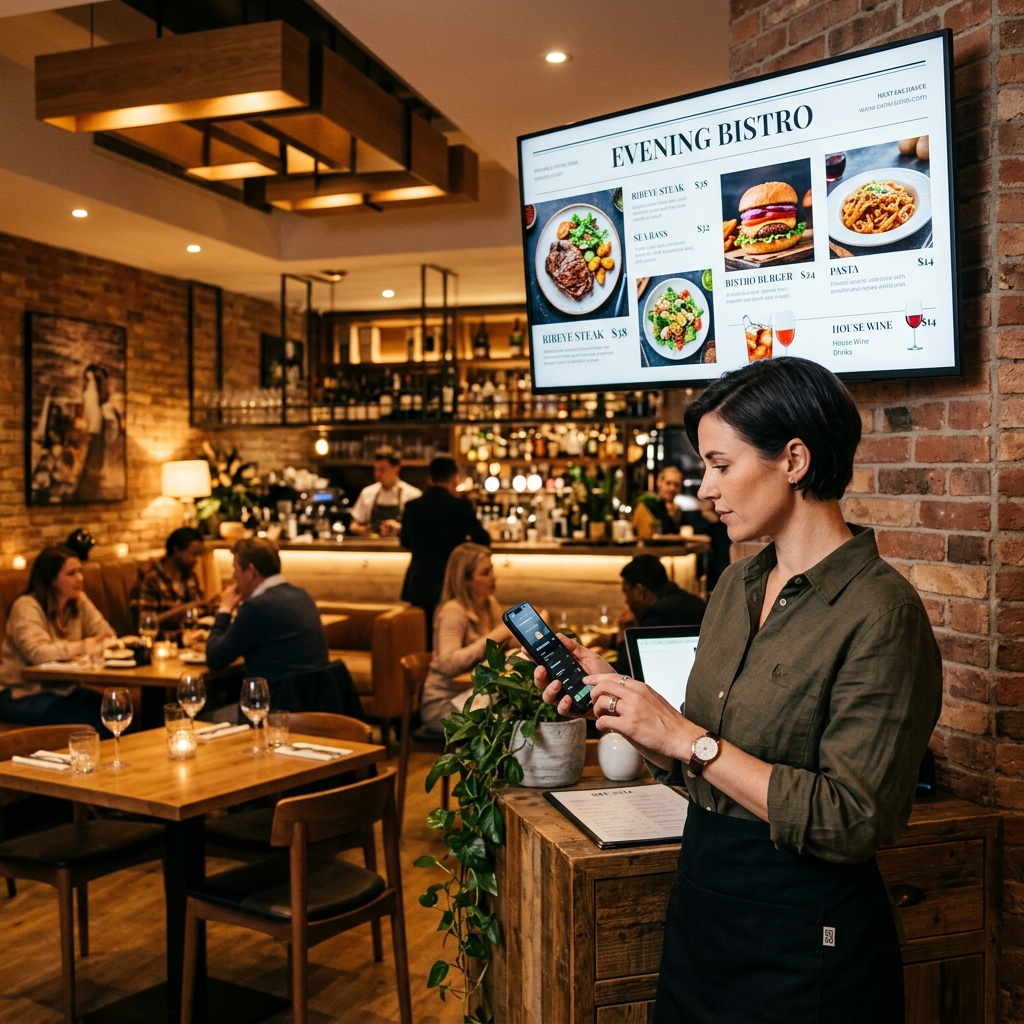
A menu board is the most-read piece of communication in a restaurant. Every customer looks at it, usually while deciding how much to spend. Yet in most venues it is a static, printed panel that is out of date the moment prices or availability change. A smart digital menu board is different: it is connected to the systems that run the restaurant, so it always reflects reality, adapts to the moment, and actively helps customers choose. This article explains what makes a menu board "smart," why the intelligence comes from integration rather than flashy screens, and how to design boards that measurably sell more.
Digital is not the same as smart
Putting a menu on a screen instead of a printed panel is a start, but a screen that simply loops a fixed image is just an expensive poster. The difference between a digital board and a smart board is connection. A smart menu board is wired into the restaurant's live data — its menu, pricing, inventory, and sales — so the content is not manually maintained but automatically driven by what is actually true right now.
The intelligence of a menu board does not come from the pixels on the wall. It comes from the data behind it. A smart board is a window onto your live operations, not a slideshow someone remembered to update.
The four pillars of a smart menu board
1. Real-time availability sync
When a smart board shares a source of truth with the POS and inventory, a sold-out item disappears from the board automatically. No customer chooses something that cannot be made; no staff member scrambles to cover a display panel. The reverse is true too: a special that becomes available can be promoted the instant it is ready. The board reflects the kitchen's reality without anyone touching it.
2. Automatic dayparting
A smart board knows what time it is and changes accordingly — breakfast in the morning, lunch midday, the full dinner menu in the evening, and a drinks-forward layout at night. Because dayparts switch on a schedule, the right offering is always on screen without manual intervention, and you can tailor both the items and the merchandising emphasis to each part of the day.
3. Data-driven merchandising
This is where the "smart" earns its name. Because the board is connected to sales data, it can be used deliberately to steer the menu mix: feature high-margin items more prominently, promote what needs to move, and de-emphasise low performers. Rather than treating every item equally, a smart board can present the menu in the order that is best for both the customer's decision and the restaurant's margin. Applied thoughtfully, this is merchandising informed by evidence rather than habit.
4. Central control across locations
For any operator with more than one site, a smart board system means managing all screens from one place. Update a price, launch a promotion, or swap a seasonal menu once and it propagates everywhere, guaranteeing brand and pricing consistency across the estate — a task that is nearly impossible with printed boards.
Why integration is the whole game
Everything valuable about a smart menu board flows from the fact that it is not a standalone signage product but an extension of the systems already running the restaurant. When the board, the POS, the menu, the pricing engine, and inventory all share one source of truth, several problems simply cease to exist:
- No drift. Prices and items on the board cannot disagree with what the till charges, because they come from the same data.
- No double entry. You maintain the menu once, not separately for the POS, the online menu, and the signage.
- No stale content. Availability and pricing are always current because they are read live, not copied by hand.
- No compliance mismatch. Displayed prices and allergen information stay consistent with what is legally charged and recorded.
A signage tool that is disconnected from the POS reintroduces all of these problems. Integration is not a nice-to-have feature of a smart board; it is the entire point.
Designing boards that sell
Smart plumbing still needs good design on top. The most effective menu boards follow a few well-established principles:
- Guide the eye. Layout, size, and placement should lead customers toward the items you most want to sell, using visual hierarchy rather than clutter.
- Limit choice per view. Too many options cause decision paralysis and slow the line. Curate what shows at any moment.
- Use imagery with intent. High-quality photos of signature and high-margin dishes are persuasive; motion draws attention but should not overwhelm.
- Keep it legible. Readable from the back of the queue, with high contrast and clear pricing.
- Reflect reality. Never show what you cannot serve; always show what you want to move.
Accessibility matters too: sufficient contrast, adequate text size, and clear language make the board work for everyone and often improve conversion for all customers, not just those with specific needs.
Where Nigmet fits
Nigmet is an AI-native restaurant operating system in which the digital menu board is driven by the same live data as the POS, menu, pricing, and QR ordering. A sold-out item drops off the board automatically; a price change appears everywhere at once; dayparts switch on schedule; and merchandising can be informed by real sales data rather than guesswork. Multi-location operators manage every screen centrally, and because the board shares one source of truth with ordering and fiscal compliance, displayed prices always match what is charged and recorded. The screen becomes a live, self-maintaining extension of the restaurant rather than one more thing to keep in sync.
The integration architecture, explained
Because integration is the whole point, it is worth understanding what "one source of truth" means in practice. In a well-architected system, there is a single menu-and-pricing dataset that every surface reads from: the POS that charges the customer, the QR menu the customer browses, and the menu board on the wall. When you change an item — its price, availability, description, or image — you change it once, in that single dataset, and every surface updates because they are all views of the same data. No copying, no exporting, no separate signage database that can drift out of sync. This is fundamentally different from a standalone signage tool, which maintains its own separate content and therefore requires someone to manually keep it aligned with the till — a task that inevitably slips.
Data-driven merchandising, in practice
The promise of a "smart" board is that it merchandises based on evidence, so it is worth making that concrete. Because the board is connected to sales data, it can support decisions such as: featuring the items with the best contribution margin more prominently; promoting items that are overstocked or approaching their use-by window to reduce waste; de-emphasising or removing persistent underperformers; and adjusting emphasis by daypart based on what actually sells when. Applied thoughtfully, this is the digital equivalent of a great floor manager constantly steering the mix — except it runs automatically, consistently, and across every location at once. The key word is thoughtfully: the aim is to help customers find what they will enjoy while improving the mix, not to manipulate.
Allergens, calories, and regulated information
Menu displays increasingly must carry more than names and prices. Depending on the market and the format, there may be expectations or requirements around allergen information and, in some jurisdictions and for some operators, calorie or nutritional labelling. A connected board has a real advantage here: because the information is drawn from the same source of truth as the recipe and menu data, it stays accurate and consistent automatically. When a recipe changes, the displayed allergen information can change with it, rather than relying on someone to remember to update a printed panel. This reduces both compliance risk and the chance of misinforming a customer with a genuine dietary need.
Beyond the counter: queues and drive-thru
Smart boards are not only for the wall behind the till. In queue-heavy formats, screens can display order-ready numbers, estimated wait times, and upsell prompts to a captive waiting audience. In drive-thru formats, dynamic boards can change by daypart, highlight combos, and reflect real-time availability so customers are not offered something that has sold out. In each case the same principle applies: the value comes from the board knowing what is true right now, which is only possible when it is connected to the systems that know.
The content workflow
A smart board still needs a sane process for the humans who run it. The best systems provide a simple content-management workflow: templates that keep everything on-brand, scheduling so content changes at the right times without manual intervention, roles and permissions so head office and individual sites each control what they should, and a preview so no one pushes a broken layout to a live screen. Good workflow is what makes the difference between signage that is lovingly maintained for two weeks and then neglected, and signage that stays sharp for years because keeping it current is nearly effortless.
Testing and measuring uplift
Because content can be changed instantly and centrally, a smart board lets you actually test what works. You can feature an item for a period and measure the sales lift, compare two presentations of the same dish, or evaluate whether a particular add-on prompt raises attachment rates. Over time this builds an evidence base for what merchandising actually moves the needle in your venue, replacing guesswork with data. Attribution is not perfect — many things influence sales — but even directional evidence, gathered cheaply because changes are instant, is far better than decorating a screen and hoping.
Hardware and cost, kept sane
Smart does not mean expensive or proprietary. Modern smart boards run on ordinary commercial displays driven by inexpensive media devices and managed over the internet, so the entry cost is modest and adding screens is easy. The durable value is in the connected content platform, not in specialised hardware — which keeps the door open to growing the number of screens as the business grows.
Static versus digital versus smart, side by side
It helps to be clear about the three tiers, because the jump in value is not linear. A static printed board is cheap to start but frozen, costly to change, and always slightly out of date. A basic digital board removes the reprint cost and adds motion, but if it is a disconnected slideshow it still has to be maintained by hand and can drift from reality. A smart, connected board is the only tier where the content maintains itself from live data — availability, pricing, and information are correct by construction, dayparting is automatic, and merchandising can be informed by real sales. The lesson is that putting a menu on a screen is not the finish line; connecting that screen to the systems that run the restaurant is what turns a display into an asset.
Seen this way, the decision is less about buying screens and more about choosing an operating system for the restaurant that happens to include the screens as one of its surfaces. That framing matters, because it is the connection — not the display itself — that delivers the compounding benefits over the years the board hangs on your wall.
The bottom line
A smart digital menu board is not a fancier poster; it is a live window onto the restaurant's real data. Its value comes from integration — real-time availability, automatic dayparting, evidence-based merchandising, and central multi-location control — all of which depend on the board sharing one source of truth with the POS, menu, and inventory. Layer disciplined design on top of that connected foundation and the board stops being a maintenance chore and starts being one of the highest-return surfaces in the venue: always accurate, always current, and quietly working to help every customer choose well and spend a little more.
Give your menu boards a live connection to your operations. Explore plans that include smart signage on our pricing page.