Title
Excerpt
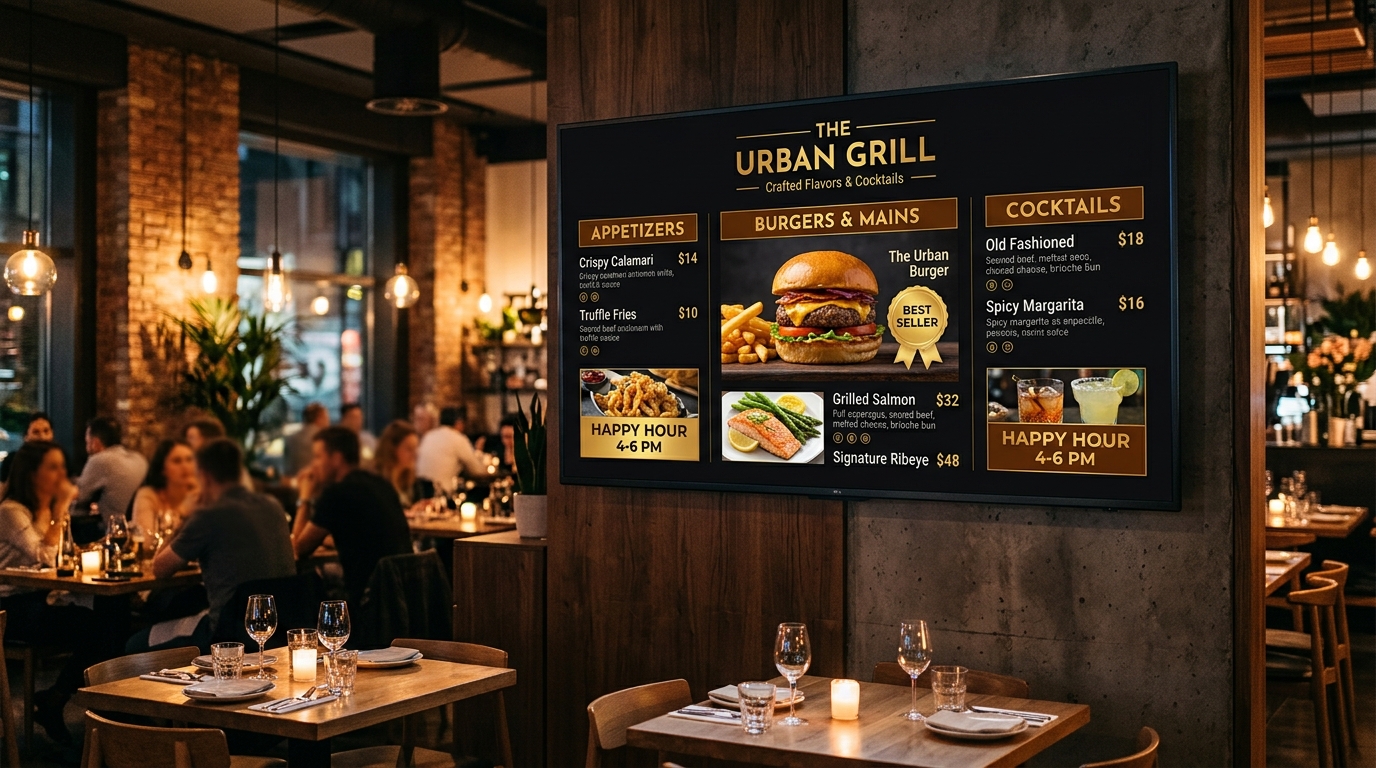
The screens on a restaurant's walls are some of the most valuable and most wasted advertising space it owns. A static menu board or a TV showing a random sports channel is a missed opportunity to sell, inform, and shape how customers feel about the brand. This article explains how digital signage and in-venue "TV broadcast" work, why dynamic screens outperform printed boards, and how to turn the displays customers are already looking at into a channel that lifts sales and cuts operating friction.
From printed boards to a live channel
A printed menu board is frozen the moment it is laminated. If a dish sells out, the price of an ingredient jumps, or you want to push a slow-moving item, you are stuck until you reprint. Digital signage replaces that rigidity with a screen you can change instantly and centrally — across one location or fifty — from a single dashboard. The board becomes a live channel rather than a static poster.
"TV broadcast" extends the same idea to the ambient screens in a venue: instead of a default cable channel, those TVs run branded content you control — daily specials, promotions, brand storytelling, upcoming events, loyalty prompts, and dayparted menus that change automatically from breakfast to lunch to dinner.
Why dynamic beats static
The advantages of digital signage are not just cosmetic. They change what the screen can do for the business.
- Instant updates. Change a price, hide a sold-out item, or launch a promotion in seconds, everywhere at once — no reprinting, no ladders, no waiting.
- Dayparting. Screens automatically switch content by time of day, so the right menu shows at the right hour without anyone touching them.
- Motion and merchandising. Video and animation draw the eye and let high-margin or signature items be showcased far more persuasively than static text.
- Consistency at scale. Every location shows the same on-brand content, which matters enormously for multi-site operators.
- Real-time integration. When signage is tied to the POS and menu system, availability and pricing on screen match reality automatically.
A static board is a cost. A connected screen is a merchandising surface — the difference is whether the content can change as fast as your business does.
The psychology of the screen
People waiting to order are a captive, receptive audience. A queue at a counter or a table waiting for service is exactly the moment a well-designed screen can guide a decision. Motion attracts attention, appetising imagery stimulates appetite, and clear, uncluttered layouts reduce the cognitive load of choosing. Used well, signage nudges customers toward high-margin items, introduces add-ons they had not considered, and reduces decision paralysis so lines move faster.
Selling without a salesperson
Signage is a tireless, consistent merchandiser. It never forgets to mention the special, never has an off day, and never varies the pitch. Dayparted content means the screen promotes pastries and coffee in the morning and shifts to dinner and drinks in the evening automatically. That is upselling that scales without adding labour.
Operational benefits beyond sales
Digital signage also removes operational friction that quietly costs money and goodwill:
- No reprint cycle. The recurring cost and delay of printing new boards for every menu or price change disappears.
- Fewer disappointed customers. Sold-out items can be pulled from the display immediately, so no one orders something you cannot make.
- Compliance and accuracy. Prices and allergen information stay correct because they update from a single source of truth.
- Event and queue management. Screens can display wait times, order-ready numbers, or event information, smoothing the customer flow.
Where Nigmet fits
Nigmet is an AI-native restaurant operating system with digital signage and in-venue broadcast built in, driven by the same menu and pricing data that powers its POS and QR ordering. Because signage shares one source of truth with ordering, a price change or a sold-out item updates on the screens automatically — no separate signage tool to keep in sync. Operators manage content centrally across locations, schedule dayparted menus and promotions, and broadcast branded content to ambient TVs, all from the same platform that runs the rest of the restaurant.
Designing signage that actually performs
A screen is only as good as what plays on it. A few principles separate signage that sells from signage that is ignored:
- One message at a time. Cluttered screens are read as noise. Give each moment a single clear focus.
- Legibility first. Large type, high contrast, and short lines readable from across the room beat dense detail.
- Show, do not just tell. High-quality imagery and short motion clips of the actual food outperform text descriptions.
- Match content to the moment. Promote what you want to sell now, to the people standing in front of the screen now.
- Keep it fresh. Rotate content so regulars do not tune it out, and always reflect real availability.
Building a content strategy, not just a playlist
The most common failure mode of digital signage is treating it as a screen to fill rather than a channel to program. A loop of random slides quickly becomes wallpaper that customers stop seeing. A content strategy treats the screen like a broadcast schedule with intent behind every segment. A workable approach:
- Define the job of each screen. A menu board above the counter has a different job (help the customer choose and order faster) than an ambient TV in the dining room (reinforce the brand and promote add-ons). Program each for its job.
- Plan a content calendar. Map what plays across the day and week — specials, promotions, seasonal items, events — so someone is deliberately deciding the message rather than leaving last month's promo up.
- Balance selling and atmosphere. Not every second should be a hard sell. Mix merchandising with brand storytelling and ambient content so the screen feels like part of the room, not an advert on loop.
- Rotate to stay fresh. Regulars tune out repetition. Refresh imagery and messaging regularly so the screen keeps earning attention.
Dayparting in depth
Dayparting — changing content by time of day — is where signage stops being static and starts matching the rhythm of the business. A café might run a fast, coffee-and-pastry-forward board in the morning rush, switch to a lunch menu with grab-and-go emphasis midday, promote afternoon deals in the quiet period to stimulate demand, and shift to a relaxed dinner-and-drinks presentation in the evening. Each daypart can emphasise different items, different price points, and a different mood. Because the switches are scheduled, none of this requires a staff member to remember to change anything — the right message simply appears at the right time, every day, consistently.
Brand storytelling and ambient TV
The ambient screens in a venue — the TVs that would otherwise show a default channel — are an underused brand asset. Instead of unrelated programming, they can tell your story: where your ingredients come from, the people behind the kitchen, your values, upcoming events, and your loyalty programme. This is not hard selling; it is atmosphere and connection, the kind of thing that turns a transaction into a relationship. It also keeps the screen on-brand and under your control rather than surrendering it to whatever happens to be broadcasting. Note that showing licensed broadcast content (such as live sport) in a commercial venue usually requires appropriate commercial licensing; running your own branded content sidesteps that complication entirely.
Reliability: what happens when the network drops
A screen that goes blank or shows an error during service is worse than a printed board. Robust signage systems cache content locally on the media device so playback continues even if the internet connection drops, syncing new content when the connection returns. When you evaluate a system, ask the same question you would ask of a POS: what exactly appears on the screen during a network outage? The answer should be "the last known good content keeps playing," not "an error message in front of every customer."
Governing signage across locations
For multi-site operators, signage is as much a governance problem as a creative one. You want brand and pricing consistency everywhere, but you may also want local flexibility — a location-specific special or event. A good system supports this with central templates and controlled local overrides: head office sets the brand, the core menu, and the promotions, while individual sites can slot in permitted local content without breaking consistency. This prevents both the chaos of every location doing its own thing and the rigidity of a system too centralised to reflect local reality.
Measuring whether signage works
Signage should be held to the same standard as any other investment: does it move numbers? While attribution is harder than for a digital ad, you can still measure. Track sales of featured items during and after a signage campaign, compare attachment rates for promoted add-ons, and watch whether dayparted promotions lift demand in targeted periods. Because a connected system lets you change content instantly, you can run simple before-and-after comparisons: feature an item for a period, measure its sales lift, and let the data inform what you promote next. Over time this turns signage from a cost you assume is helping into a channel you know is performing.
Accuracy, allergens, and compliance on screen
When prices and product information are displayed publicly, accuracy is not just good practice — it can be a legal expectation. Displayed prices should match what is charged, and allergen or dietary information, where shown, must be correct. A signage system that reads from the same source of truth as the POS and menu keeps these consistent automatically, so a price change or a recipe change cannot leave a misleading claim on the wall. This is a quiet but real advantage of integrated signage over standalone slideshow tools that have no idea what the till is actually charging.
Hardware without the headache
Digital signage used to imply expensive proprietary media players and complex installs. Modern systems run on ordinary commercial displays or TVs driven by inexpensive media devices, managed over the internet. That keeps the entry cost low and makes it easy to add screens as you grow — the value lives in the content platform, not in locked-down hardware.
Common mistakes to avoid
Because signage is easy to get wrong, it helps to know the traps that undermine it:
- Treating it as decoration. A screen with no strategy is money spent to be ignored; give every screen a job.
- Cramming too much on one view. Cluttered screens read as noise and slow decisions; one clear message at a time wins.
- Set-and-forget content. Stale promotions train customers to stop looking; fresh, rotating content keeps attention.
- Disconnecting from the POS. Standalone signage drifts out of sync with real prices and availability; integration prevents it.
- Ignoring legibility and accessibility. If it cannot be read from the queue, it cannot sell.
Avoiding these is mostly a matter of assigning ownership. When one person or role is clearly responsible for what appears on the screens — planning the calendar, refreshing content, and checking that displays match reality — signage stays sharp. When it is nobody's job, it decays into wallpaper regardless of how good the underlying system is. The technology enables great signage; a small amount of human intent is what sustains it. The good news is that when the board is connected to your POS and menu, most of the accuracy work happens automatically, leaving that owner free to focus on creative and merchandising decisions rather than on manual upkeep.
The bottom line
The screens in a restaurant are prime real estate, and static boards leave most of that value on the table. Digital signage and in-venue broadcast turn those displays into a live, centrally controlled merchandising channel that updates instantly, dayparts automatically, sells high-margin items without extra labour, and keeps prices and availability accurate. When the signage shares data with your POS and menu, it stops being one more thing to maintain and becomes an automatic extension of how your restaurant already runs.
Turn your walls into a channel that sells. Explore plans that include digital signage on our pricing page.